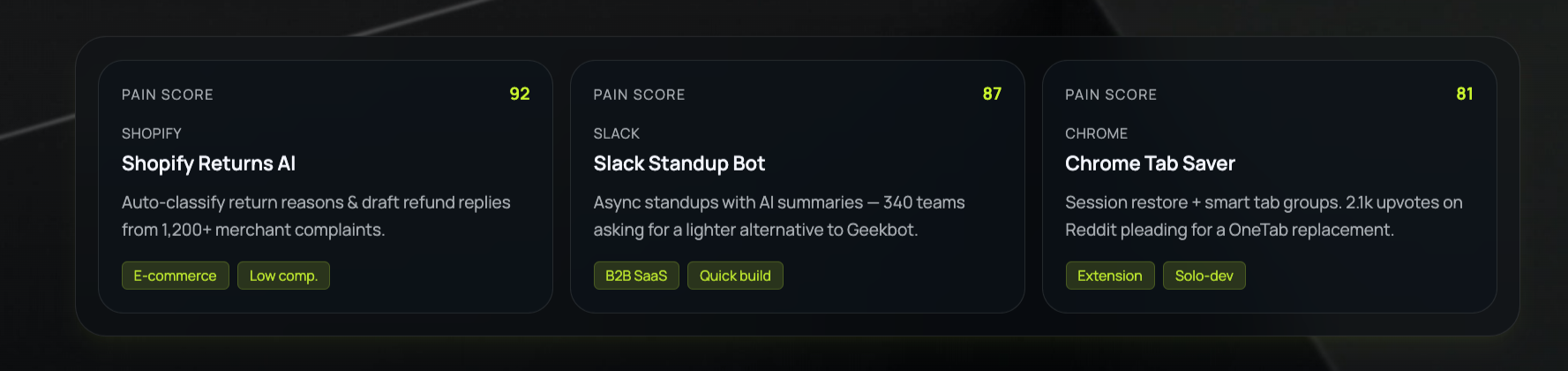

Here's a number that should bother you. Most indie products fail not because they were built badly, but because nobody asked whether the problem was worth solving in the first place. Founders spend months building based on a hunch, a half-formed idea, or something they saw trending on Twitter for a week. TrendGap exists because guessing is expensive and data is sitting right there in plain sight. Every day, scrapers pull thousands of negative reviews from G2, Capterra, the App Store, Shopify App Store, Product Hunt, and Reddit. Not the five-star reviews. The complaints. The one-star rants. The "I switched because this tool couldn't do X" posts that most people scroll past. That is where the actual opportunities live. An AI layer processes all of it, clusters the complaints by theme, and calculates a Market Pain Score for each emerging gap. You get a number, not a vibe. A 91 pain score means thousands of people are actively frustrated and the incumbents serving them are weak. You also get the TAM signal, the estimated build time, and a breakdown of exactly how bad the current competition is rated. One report on the platform right now shows a Shopify B2B wholesale pricing gap. Pain score of 91. Sourced from over 4,000 reviews. A $48 million addressable market. Every existing competitor in that space rated under 3.5 stars. That is not a hunch. That is a documented gap with proof links straight back to the original complaints. Once you find a niche, you are not left to figure out the rest alone. You get a ready-to-code blueprint, a recommended tech stack, and a go-to-market playbook built around the specific pain points people are already complaining about. Build it with whatever tool you want. Cursor, Claude, ChatGPT, Lovable, it does not matter. TrendGap validates the problem. You ship the solution.