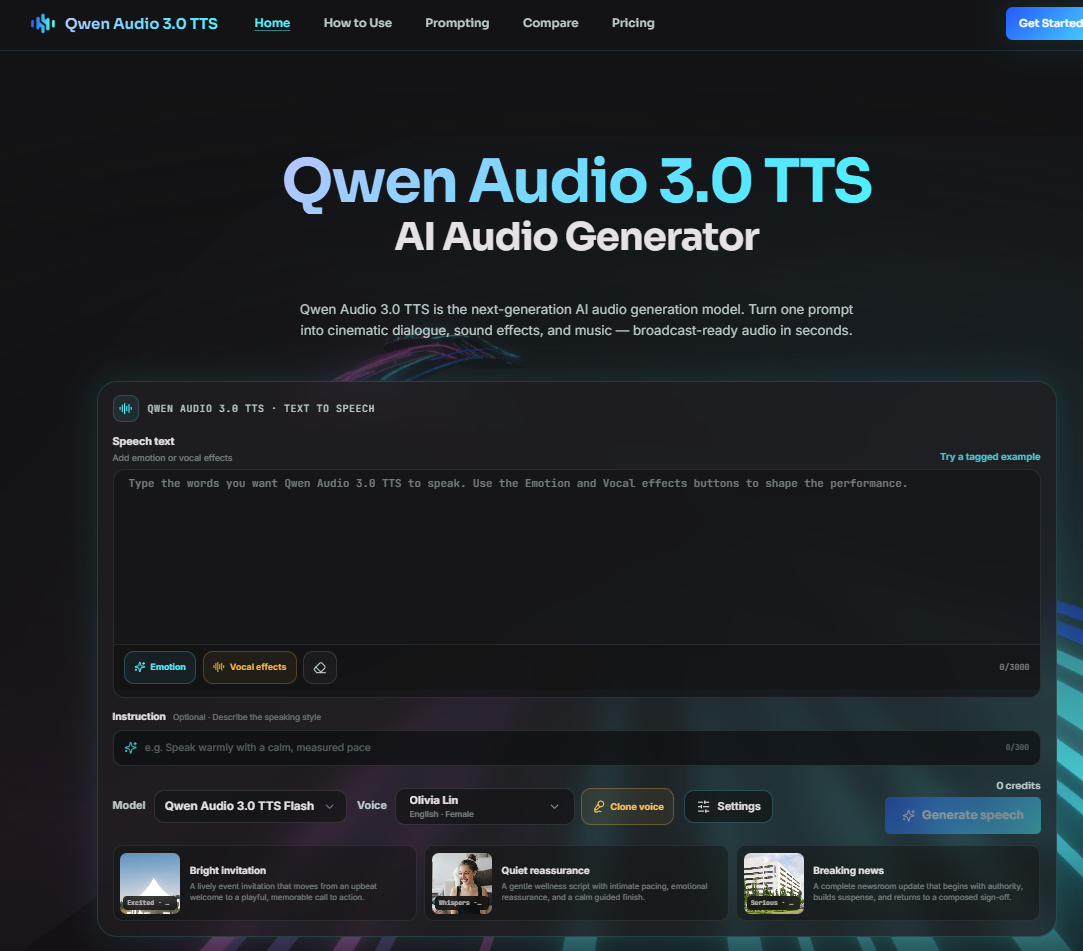

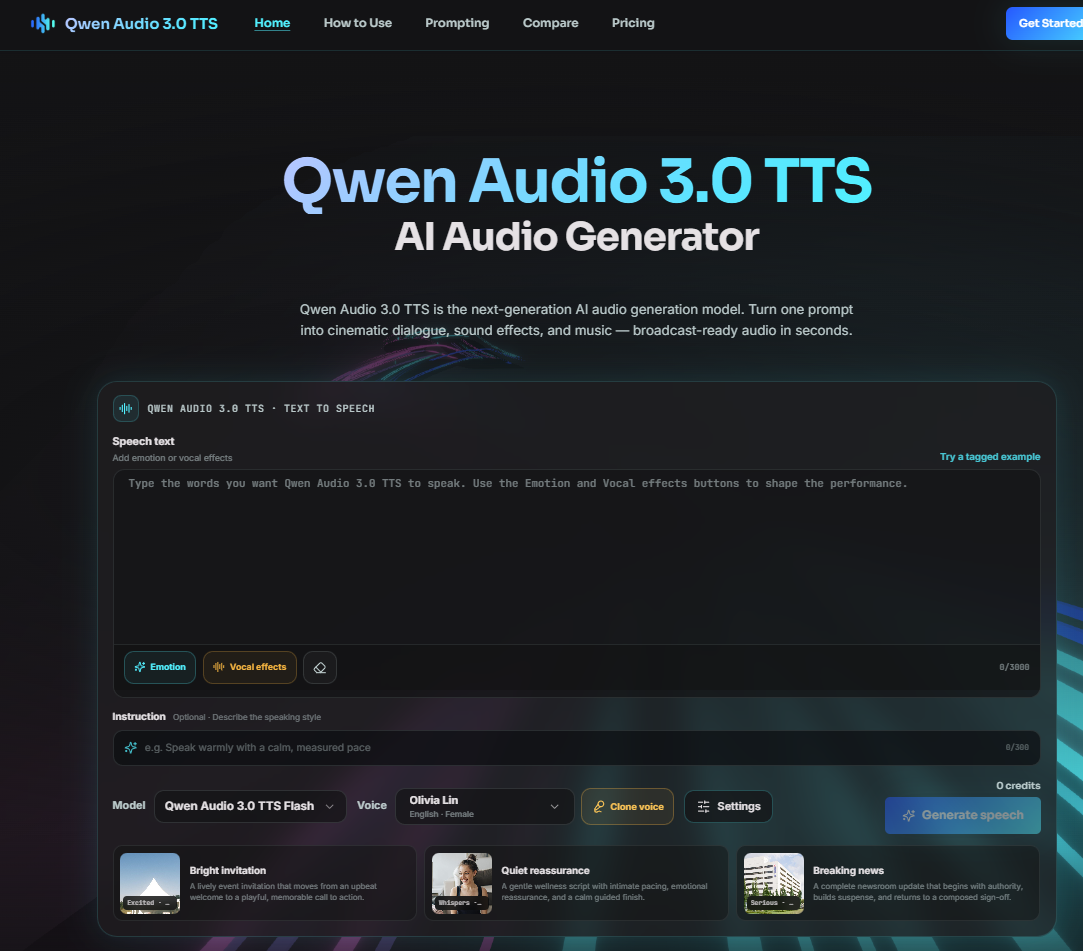
When we started building **Qwen Audio 3.0 TTS**, we noticed that many text-to-speech tools had become good at generating understandable speech, but they still struggled with something people immediately notice: natural expression. Most TTS systems offer a list of preset voices and a few sliders for speed or pitch. They work for simple narration, but once creators want a podcast-style voice, emotional storytelling, product videos, multilingual content, or AI assistants that sound more human, the workflow quickly becomes limiting. We wanted to build a platform where generating speech feels closer to directing a voice actor than configuring software. Qwen Audio 3.0 TTS allows users to describe how a voice should sound using natural language instead of complicated settings. Rather than choosing between "Voice A" or "Voice B," users can request a calm teacher, an energetic presenter, a friendly customer support agent, or a dramatic narrator. The model interprets these instructions and produces expressive speech while maintaining natural pronunciation and pacing. Another challenge we wanted to solve was multilingual production. Content creators increasingly publish videos, courses, podcasts, and product demos for audiences around the world, yet creating high-quality voiceovers in multiple languages often requires several different tools and extensive manual editing. Our platform supports up to sixteen languages and helps users generate consistent voices across different languages from a single workflow. We also focused on flexibility. Some users need extremely fast responses for conversational AI or interactive applications, while others prioritize audio quality for commercial production. That's why the platform provides different generation modes, allowing developers and creators to choose the balance between speed and quality that best fits their projects. For professional creators, voice consistency is just as important as voice quality. Features such as zero-shot voice cloning, long-form speech generation, and natural control over pauses, emphasis, and speaking style help produce content that feels less synthetic and requires less post-editing. Our goal isn't simply to generate speech from text. We want to reduce the amount of manual work between an idea and a finished piece of audio. Whether someone is creating YouTube videos, audiobooks, educational materials, marketing campaigns, AI assistants, podcasts, or localized content for global audiences, the platform is designed to make expressive speech generation faster and more accessible. What makes Qwen Audio 3.0 TTS different is not just the quality of its voices, but the way users interact with the model. Instead of relying on complicated parameter tun