
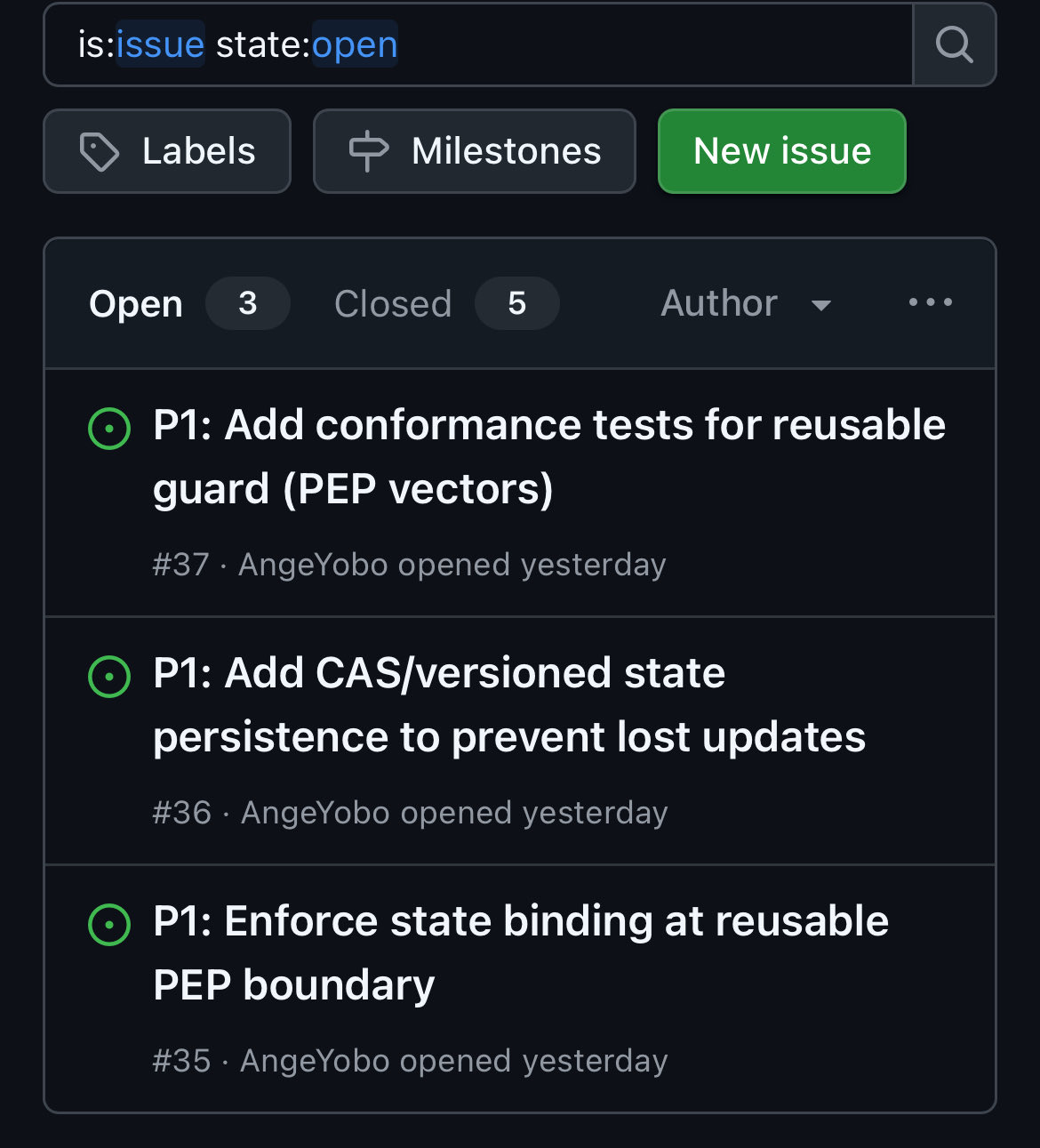
Every AI agent safety conversation ends up in the same place. Better prompts. Smarter guardrails. More monitoring. Better logging. None of it actually stops an agent from executing something it should not. It just makes the aftermath easier to understand. That is the wrong layer to work at. OxDeAI moves the control point to before execution. Not during. Not after. Before. The moment an agent proposes an action, OxDeAI evaluates it against intent, state, and policy and produces a deterministic decision. ALLOW or DENY. Same input, same decision, every single time. If the decision is DENY, execution is not just blocked — it is unreachable. There is no path to the side effect. The enforcement happens at a PEP Gateway that every tool call must pass through. There is no bypass route. No way for the agent to call a tool directly. No execution path outside the boundary. Authorization is verified, the intent hash is checked, replay protection is enforced, and only then does execution become reachable. This matters because agents are no longer just answering questions. They are writing to databases, sending emails, making API calls, moving money, and taking actions with real consequences. Probabilistic guardrails were fine when the worst case was a bad answer. They are not fine when the worst case is a duplicated payment or a leaked credential. OxDeAI is a protocol, not a framework. It works across LangGraph, OpenAI Agents SDK, CrewAI, AutoGen, and OpenClaw. The TypeScript, Go, and Python implementations all produce identical canonical bytes and hashes. Cross-language verification runs in CI on every commit. Open source. MIT licensed. Built for the teams who understand that production-safe agents need deterministic execution boundaries, not better vibes.